This page provides comprehensive Ch 3: The World of Numbers – End-of-Chapter Exercises. Questions cover long division of rationals, proving irrationality, converting decimals to $\frac{p}{q}$ form, locating numbers on a number line, finding rationals between two values, terminating decimal conditions, and the square root spiral. Includes starred challenge problems.
Comprehensive Review — The World of Numbers
Q1: Long Division — Terminating or Repeating?
Convert the following rational numbers in the form of a terminating decimal or non-terminating and repeating decimal, whichever the case may be, by the process of long division:
(i) $\dfrac{3}{50}$ (ii) $\dfrac{2}{9}$
(i) $\dfrac{3}{50}$: $50 = 2 \times 5^2$ — only factors 2 and 5, so the decimal terminates.
Long division: $3 \div 50 = 0.06$
$$\frac{3}{50} = 0.06$$
(ii) $\dfrac{2}{9}$: $9 = 3^2$ — contains the prime 3, so the decimal is non-terminating and repeating.
Long division: $2 \div 9 = 0.222\ldots$
$$\frac{2}{9} = 0.\overline{2}$$
(i) $\dfrac{3}{50} = 0.06$ (terminating) (ii) $\dfrac{2}{9} = 0.\overline{2}$ (repeating)
Q2: Prove √5 is Irrational
Prove that $\sqrt{5}$ is an irrational number.
Proof by contradiction: Assume, for contradiction, that $\sqrt{5}$ is rational. Then we can write:
$$\sqrt{5} = \frac{p}{q}$$
where $p$ and $q$ are integers, $q \neq 0$, and $\gcd(p, q) = 1$ (i.e., the fraction is in its lowest terms).
Squaring both sides:
$$5 = \frac{p^2}{q^2} \implies p^2 = 5q^2$$
This means $5 \mid p^2$ (5 divides $p^2$). Since 5 is prime, by Euclid's lemma, $5 \mid p$.
So we can write $p = 5k$ for some integer $k$.
Substituting $p = 5k$:
$$(5k)^2 = 5q^2 \implies 25k^2 = 5q^2 \implies q^2 = 5k^2$$
This means $5 \mid q^2$, so by Euclid's lemma again, $5 \mid q$.
But now we have $5 \mid p$ and $5 \mid q$, which means $\gcd(p, q) \geq 5$. This contradicts our assumption that $\gcd(p, q) = 1$.
Therefore our initial assumption is false, and $\sqrt{5}$ is irrational. $\blacksquare$
$\sqrt{5}$ is irrational — proven by contradiction using Euclid's lemma.
Q3: Convert Decimals to p/q Form
Convert the following decimal numbers in the form of $\dfrac{p}{q}$:
(iii) $3.0\overline{52}$ — 2 non-repeating decimal places, block of 2:
Let $x = 3.05252\ldots$
$100x = 305.252\ldots$ and $10x = 30.5252\ldots$
$$100x - 10x = 305.252\ldots - 30.5252\ldots = 274.727... $$
Let me redo carefully. The non-repeating part is "30", repeating is "52":
Multiply by $10$ (shift past non-repeating): $10x = 30.5252...$
Multiply by $1000$ (shift past non-repeating + one period): $1000x = 3052.5252...$
$$1000x - 10x = 3052.5252\ldots - 30.5252\ldots = 3022$$
$$990x = 3022 \implies x = \frac{3022}{990} = \frac{1511}{495}$$
(iv) $1.\overline{235}$ — repeating block of 3 from the start:
Let $x = 1.235235\ldots$
$$1000x = 1235.235\ldots$$
$$1000x - x = 1234 \implies 999x = 1234 \implies x = \frac{1234}{999}$$
(v) $0.\overline{23}$ — repeating block of 2:
Let $x = 0.232323\ldots$
$$100x = 23.232323\ldots$$
$$99x = 23 \implies x = \frac{23}{99}$$
(vi) $2.0\overline{5}$ — 1 non-repeating place, block of 1:
Let $x = 2.0555\ldots$
$10x = 20.555\ldots$ and $100x = 205.555\ldots$
$$100x - 10x = 205.555\ldots - 20.555\ldots = 185$$
$$90x = 185 \implies x = \frac{185}{90} = \frac{37}{18}$$
(vii) $2.1\overline{25}$ — 1 non-repeating place, block of 2:
Let $x = 2.12525\ldots$
$10x = 21.2525\ldots$ and $1000x = 2125.2525\ldots$
$$1000x - 10x = 2125.2525\ldots - 21.2525\ldots = 2104$$
$$990x = 2104 \implies x = \frac{2104}{990} = \frac{1052}{495}$$
Locate the following rational numbers on the number line.
(i) $0.532$ (ii) $1.15$
(i) $0.532$: $0.532$ lies between 0 and 1. More precisely, it lies between $0.5$ and $0.6$ (between $\frac{1}{2}$ and $\frac{3}{5}$).
To locate precisely: divide the unit segment $[0, 1]$ into 1000 equal parts; $0.532$ is at the 532nd mark from 0.
Alternatively: divide $[0.5, 0.6]$ into 10 equal parts; $0.532$ is 3.2 parts along that sub-segment.
(ii) $1.15$: $1.15$ lies between 1 and 2. More precisely between $1.1$ and $1.2$.
To locate precisely: divide the segment $[1, 2]$ into 100 equal parts; $1.15$ is at the 15th mark from 1.
Or note that $1.15 = 1\frac{3}{20}$ — three-twentieths of the way past 1.
$0.532$ lies between 0.5 and 0.6; $1.15$ lies between 1.1 and 1.2 on the number line.
Q5: Six Rationals Between 3 and 4
Find 6 rational numbers between 3 and 4.
Multiply numerator and denominator of both bounds to get room for 6 integers between them:
$$3 = \frac{3 \times 8}{8} = \frac{24}{8} \qquad 4 = \frac{4 \times 8}{8} = \frac{32}{8}$$
Integers strictly between 24 and 32: $25, 26, 27, 28, 29, 30, 31$ — we need only 6.
Six rational numbers between 3 and 4:
$$\frac{25}{8},\quad \frac{26}{8},\quad \frac{27}{8},\quad \frac{28}{8},\quad \frac{29}{8},\quad \frac{30}{8}$$
Simplified: $\dfrac{25}{8},\ \dfrac{13}{4},\ \dfrac{27}{8},\ \dfrac{7}{2},\ \dfrac{29}{8},\ \dfrac{15}{4}$
Find 5 rational numbers between $\dfrac{1}{6}$ and $\dfrac{2}{5}$.
Find the LCD of 6 and 5: LCD $= 30$.
$$\frac{1}{6} = \frac{5}{30} \qquad \frac{2}{5} = \frac{12}{30}$$
Integers strictly between 5 and 12: $6, 7, 8, 9, 10, 11$. We need only 5.
If $\dfrac{x}{3} + \dfrac{x}{5} = \dfrac{16}{15}$, find the rational number $x$.
Find the LCD of 3 and 5, which is 15. Rewrite the left side:
$$\frac{x}{3} + \frac{x}{5} = \frac{5x}{15} + \frac{3x}{15} = \frac{8x}{15}$$
Set equal to the right side:
$$\frac{8x}{15} = \frac{16}{15}$$
$$8x = 16 \implies x = 2$$
$x = 2$
Q9: Sign of ab When a + 1/b = 0
Let $a$ and $b$ be two non-zero rational numbers such that $a + \dfrac{1}{b} = 0$. Without assigning any numerical values, determine whether $ab$ is positive or negative. Justify your answer.
From the given condition $a + \dfrac{1}{b} = 0$:
$$a = -\frac{1}{b}$$
Now compute $ab$:
$$ab = \left(-\frac{1}{b}\right) \times b = -\frac{b}{b} = -1$$
Since $ab = -1$ regardless of the actual values of $a$ and $b$ (as long as they are non-zero), $ab$ is always negative (equal to $-1$).
Alternatively: $a = -\dfrac{1}{b}$ means $a$ and $b$ must have opposite signs (one positive, one negative), so their product $ab$ must be negative.
$ab = -1$, which is negative. Since $a = -\dfrac{1}{b}$, $a$ and $b$ always have opposite signs.
Q10: Terminating Decimal — Denominator Structure
A rational number has a terminating decimal expansion whose last non-zero digit occurs in the 4th decimal place. Show that such a number can be written in the form $\dfrac{p}{10^n}$, where $p$ is an integer not divisible by 10. Is it necessary that the denominator of this rational number, when written in the lowest form, is divisible by $2^4$ or $5^4$? Give reasons.
Part 1 — Writing in the form $\dfrac{p}{10^n}$: A decimal terminating at the 4th place has the form $0.d_1 d_2 d_3 d_4$ where $d_4 \neq 0$.
Multiplying numerator and denominator by $10^4$:
$$x = \frac{d_1 d_2 d_3 d_4}{10^4} = \frac{p}{10^4}$$
where $p = d_1 d_2 d_3 d_4$ is an integer. Since $d_4 \neq 0$ (the last digit is non-zero), $p$ is not divisible by 10.
Part 2 — Must the denominator (in lowest terms) be divisible by $2^4$ or $5^4$? Not necessarily. Consider two cases:
Example 1: $x = 0.0625 = \dfrac{625}{10000} = \dfrac{1}{16} = \dfrac{1}{2^4}$.
Here the denominator in lowest terms is $2^4$ — divisible by $2^4$ but not $5^4$.
Example 2: $x = 0.1250 = \dfrac{1250}{10000} = \dfrac{1}{8} = \dfrac{1}{2^3}$.
Here the last non-zero digit is in the 3rd place, not the 4th.
Example 3: $x = 0.3125 = \dfrac{3125}{10000} = \dfrac{5}{16} = \dfrac{5}{2^4}$.
The denominator is $2^4$, not $5^4$.
In general, $\dfrac{p}{10^4} = \dfrac{p}{2^4 \times 5^4}$. After simplifying, the denominator will be of the form $2^a \times 5^b$ where $0 \leq a \leq 4$ and $0 \leq b \leq 4$. It is not necessary that both $2^4$ and $5^4$ divide the denominator — one or both powers could be less than 4 after simplification.
The number can always be written as $\dfrac{p}{10^4}$ with $p$ not divisible by 10. The denominator in lowest form is of the form $2^a \times 5^b$ with $a, b \leq 4$, but need not equal exactly $2^4$ or $5^4$.
Q11: Is 18/125 Terminating?
Without performing division, determine whether the decimal expansion of $\dfrac{18}{125}$ is terminating or non-terminating. If it terminates, state the number of decimal places.
First check if the fraction is in lowest terms:
$$\gcd(18, 125): \quad 18 = 2 \times 3^2, \quad 125 = 5^3$$
No common factors, so $\dfrac{18}{125}$ is already in lowest terms.
Now factorise the denominator:
$$125 = 5^3$$
The denominator contains only the prime 5 (no factor of 3 or any other prime), so the decimal terminates.
To find the number of decimal places, multiply to get a power of 10 in the denominator:
$$\frac{18}{125} = \frac{18}{5^3} = \frac{18 \times 2^3}{5^3 \times 2^3} = \frac{18 \times 8}{10^3} = \frac{144}{1000} = 0.144$$
The decimal terminates in 3 decimal places.
$\dfrac{18}{125} = 0.144$ — terminating, with 3 decimal places.
Q12: Decimal Places for Denominator 2³ × 5
A rational number in its lowest form has denominator $2^3 \times 5$. How many decimal places will its decimal expansion have? Explain your answer.
The denominator is $2^3 \times 5^1$. Since it contains only the primes 2 and 5, the decimal terminates.
To express as a terminating decimal, we convert the denominator to a power of 10. We need equal powers of 2 and 5:
$$2^3 \times 5^1 \longrightarrow \text{multiply top and bottom by } 5^2 = 25$$
$$\frac{p}{2^3 \times 5} \times \frac{5^2}{5^2} = \frac{25p}{2^3 \times 5^3} = \frac{25p}{10^3}$$
The denominator becomes $10^3$, giving a decimal with 3 decimal places.
The key is: the number of decimal places equals $\max(a, b)$ where the denominator is $2^a \times 5^b$.
Here $a = 3$, $b = 1$, so $\max(3, 1) = 3$.
The decimal expansion will have 3 decimal places, since we need $10^3$ (the larger of $2^3$ and $5^1$) in the denominator.
*Q13: Finding n Rationals Using a Common Denominator
Let $a = \dfrac{7}{12}$ and $b = \dfrac{5}{6}$. Express both $a$ and $b$ in the form $\dfrac{k_1}{m}$ and $\dfrac{k_2}{m}$, where $k_1$, $k_2$ and $m$ are integers and $k_2 - k_1 > 6$. Using the same denominator $m$, write exactly five distinct rational numbers lying between $a$ and $b$ keeping an integer numerator. Explain why the condition $k_2 - k_1 = n + 1$ is necessary to find $n$ such rational numbers between $a$ and $b$ using this method.
Step 1 — Express with a common denominator where $k_2 - k_1 > 6$: LCD of 12 and 6 is 12, but $\dfrac{7}{12}$ and $\dfrac{10}{12}$ give $k_2 - k_1 = 3$, which is not $> 6$.
Scale up to $m = 84$ (multiply by 7):
$$a = \frac{7}{12} = \frac{49}{84}, \qquad b = \frac{5}{6} = \frac{70}{84}$$
$k_1 = 49$, $k_2 = 70$, $k_2 - k_1 = 21 > 6$. ✓
Step 2 — Five distinct rationals with integer numerators between $\dfrac{49}{84}$ and $\dfrac{70}{84}$: Choose any 5 integers strictly between 49 and 70: $50, 55, 60, 65, 69$ (for variety).
$$\frac{50}{84} = \frac{25}{42},\quad \frac{55}{84},\quad \frac{60}{84} = \frac{5}{7},\quad \frac{65}{84},\quad \frac{69}{84} = \frac{23}{28}$$
Step 3 — Why $k_2 - k_1 = n + 1$ is necessary: When using a common denominator $m$, rational numbers with integer numerators between $a = \dfrac{k_1}{m}$ and $b = \dfrac{k_2}{m}$ are exactly:
$$\frac{k_1 + 1}{m},\ \frac{k_1 + 2}{m},\ \ldots,\ \frac{k_2 - 1}{m}$$
The number of such fractions is $(k_2 - 1) - (k_1 + 1) + 1 = k_2 - k_1 - 1$.
For this to equal $n$, we need $k_2 - k_1 - 1 = n$, i.e., $k_2 - k_1 = n + 1$.
If $k_2 - k_1 \leq n$, there are not enough integer numerators available between $k_1$ and $k_2$ to find $n$ distinct rationals using this method alone.
Five rationals: $\dfrac{25}{42},\ \dfrac{55}{84},\ \dfrac{5}{7},\ \dfrac{65}{84},\ \dfrac{23}{28}$. The condition $k_2 - k_1 = n + 1$ ensures exactly $n$ integer numerators exist strictly between $k_1$ and $k_2$.
*Q14: Prove x = y = z = 0
Three rational numbers $x$, $y$, $z$ satisfy $x + y + z = 0$ and $xy + yz + zx = 0$. Show that all the rational numbers $x$, $y$, $z$ must be simultaneously zero.
Key identity: For any three numbers,
$$(x + y + z)^2 = x^2 + y^2 + z^2 + 2(xy + yz + zx)$$
Substitute the given conditions $x + y + z = 0$ and $xy + yz + zx = 0$:
$$0^2 = x^2 + y^2 + z^2 + 2(0)$$
$$0 = x^2 + y^2 + z^2$$
Since $x$, $y$, $z$ are rational numbers (hence real numbers), their squares are each $\geq 0$:
$$x^2 \geq 0, \quad y^2 \geq 0, \quad z^2 \geq 0$$
The only way three non-negative quantities can sum to zero is if each is individually zero:
$$x^2 = 0,\quad y^2 = 0,\quad z^2 = 0$$
$$\implies x = 0,\quad y = 0,\quad z = 0 \qquad \blacksquare$$
Using $(x+y+z)^2 = x^2+y^2+z^2+2(xy+yz+zx)$, both conditions give $x^2+y^2+z^2=0$, forcing $x=y=z=0$.
*Q15: The Average Lies Between a and b
Show that the rational number $\dfrac{a+b}{2}$ lies between the rational numbers $a$ and $b$.
Without loss of generality, assume $a \lt b$ (the case $a > b$ is symmetric).
We need to show: $a \lt \dfrac{a+b}{2} \lt b$.
Left inequality: $a \lt \dfrac{a+b}{2}$
$$a \lt \frac{a+b}{2}$$
$$2a \lt a + b \quad \text{(multiply both sides by 2, positive)}$$
$$a \lt b \quad \checkmark \text{ (this is our assumption)}$$
Right inequality: $\dfrac{a+b}{2} \lt b$
$$\frac{a+b}{2} \lt b$$
$$a + b \lt 2b$$
$$a \lt b \quad \checkmark \text{ (again our assumption)}$$
Both inequalities hold whenever $a \lt b$, so $a \lt \dfrac{a+b}{2} \lt b$ is proven.
Note: since $a$ and $b$ are rational, $a + b$ is rational, and $\dfrac{a+b}{2}$ is also rational (division by 2 of a rational number is rational). So the midpoint is both between $a$ and $b$ and rational. $\blacksquare$
$a \lt \dfrac{a+b}{2} \lt b$ is proven from $a \lt b$ by simple algebra. The midpoint of any two rationals is itself rational and lies strictly between them.
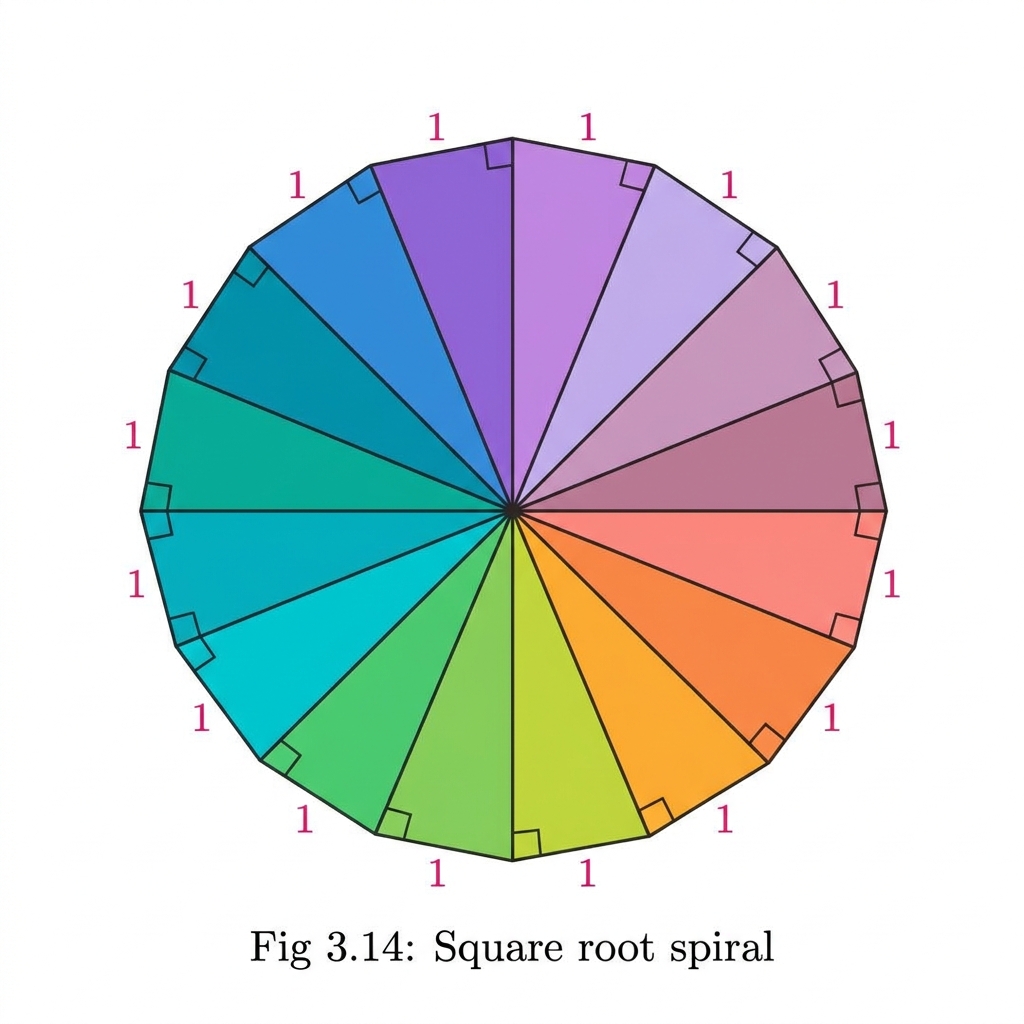
Q16: Square Root Spiral — Hypotenuse Lengths
Find the lengths of the hypotenuses of all the right triangles in Fig. 3.14 which is referred to as the square root spiral. (Each new right triangle uses a leg of length 1 and the previous hypotenuse as its other leg.)
Fig 3.14: Square root spiral
Pattern: Each right triangle has one leg of length 1 and the other leg equal to the hypotenuse of the previous triangle.
Using the Pythagorean theorem $h_n = \sqrt{h_{n-1}^2 + 1}$ with $h_1 = \sqrt{1^2 + 1^2} = \sqrt{2}$:
General pattern:
$$h_n = \sqrt{n+1}$$
The $n$-th hypotenuse (counting from the first triangle with two legs of 1) equals $\sqrt{n+1}$.
The hypotenuse lengths are: $\sqrt{2},\ \sqrt{3},\ 2,\ \sqrt{5},\ \sqrt{6},\ \sqrt{7},\ 2\sqrt{2},\ 3,\ \sqrt{10},\ \sqrt{11},\ 2\sqrt{3},\ \sqrt{13},\ \ldots$
In general, the $n$-th triangle has hypotenuse $\sqrt{n+1}$.