Exercise 1.1 Practice
00:00
Overview
This page provides Class 9 Maths Exercise 1.1 practice for The Use of Coordinates, including position description, ordered pairs, and coordinate-grid reasoning.
Coordinate Basics and Position Mapping
Q1: Position on a Table
Describe the position of an object kept on a rectangular table using two perpendicular edges as reference lines.
Choose one edge as the horizontal reference and the adjacent edge as the vertical reference.
Measure the object's distance from both edges.
The position can be written as an ordered pair of distances, such as $(x, y)$.
Q2: Ordered Pair
If a point is 4 units to the right of the vertical axis and 3 units above the horizontal axis, write its ordered pair.
The horizontal distance gives the first coordinate.
The vertical distance gives the second coordinate.
The ordered pair is $(4, 3)$.
Q3: Locate a Point
What does the ordered pair $(0, 5)$ tell you about the point's position?
The first coordinate is 0, so the point lies on the vertical axis.
The second coordinate is 5, so the point is 5 units above the origin.
The point lies on the positive vertical axis, 5 units above the origin.
Q4: Room Layout Map
Fig. 1.3 shows Reiaan’s room with points $O, A, B, C$ marking its corners. The $x$- and $y$-axes are marked in the figure. Point $O$ is the origin. Referring to Fig. 1.3, answer the following questions:
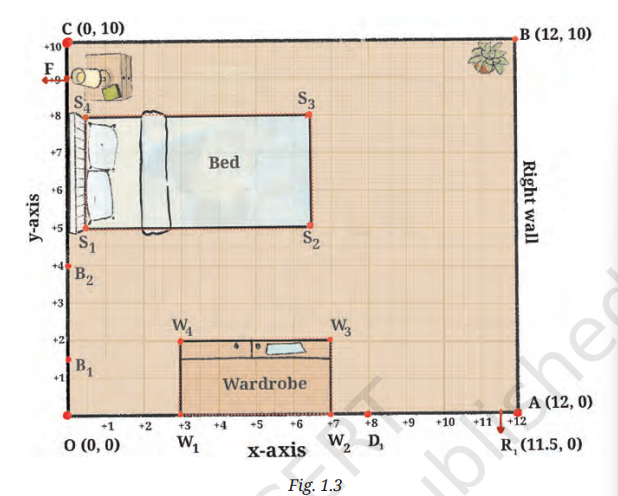
- If $D_1 R_1$ represents the door to Reiaan’s room, how far is the door from the left wall (the $y$-axis) of the room? How far is the door from the $x$-axis?
- What are the coordinates of $D_1$?
- If $R_1$ is the point $(11.5, 0)$, how wide is the door? Do you think this is a comfortable width for the room door? If a person in a wheelchair wants to enter the room, will he/she be able to do so easily?
- If $B_1 (0, 1.5)$ and $B_2 (0, 4)$ represent the ends of the bathroom door, is the bathroom door narrower or wider than the room door?
(i) Distance from walls:
- The door starts at $D_1$ on the $x$-axis. In the figure, the point $D_1$ aligns with grid tick $8$ on the $x$-axis. Therefore, the distance of the door from the left wall (the $y$-axis) is $8$ units.
- Since the door lies along the floor/wall $OA$ (the $x$-axis), the distance of the door from the $x$-axis is $0$ units.
(ii) Coordinates of $D_1$:
- The point $D_1$ is at $8$ on the $x$-axis and lies on the $x$-axis. Therefore, its $y$-coordinate is $0$.
- Thus, the coordinates of $D_1$ are $(8, 0)$.
(iii) Door width and accessibility:
- The door starts at $D_1 (8, 0)$ and ends at $R_1 (11.5, 0)$.
- The width of the door is the distance between these two points: $11.5 - 8 = 3.5$ units.
- Assuming standard grid units (where $1$ unit typical represents $1$ foot or $0.3$ meters):
- If $1\text{ unit} = 1\text{ foot}$, the door width is $3.5\text{ feet} \approx 107\text{ cm}$, which is extremely comfortable.
- If $1\text{ unit} = 0.3\text{ m}$, the door width is $3.5 \times 0.3\text{ m} = 1.05\text{ m}$ ($105\text{ cm}$).
- Since standard wheelchair accessibility regulations recommend a minimum door clearance width of at least $32\text{ inches}$ ($80\text{ cm}$ or $\approx 2.7$ units) for easy access, a width of $3.5$ units is more than sufficient. Hence, a person in a wheelchair will be able to enter easily.
(iv) Comparison with bathroom door:
- The bathroom door ends are at $B_1 (0, 1.5)$ and $B_2 (0, 4)$ on the $y$-axis.
- The width of the bathroom door is the distance between these points: $4 - 1.5 = 2.5$ units.
- Comparing the door widths: the room door is $3.5$ units wide, and the bathroom door is $2.5$ units wide.
- Therefore, the bathroom door is narrower than the room door.
Summary Answers:
- Distance from left wall = $8$ units; Distance from $x$-axis = $0$ units.
- Coordinates of $D_1$ are $(8, 0)$.
- Door width = $3.5$ units. Yes, it is a comfortable width and a wheelchair can enter easily.
- The bathroom door ($2.5$ units) is narrower than the room door ($3.5$ units).